For schools
Classroom handouts
- Free, with no adverts.
- Pupils never need an account.
- Location is optional and never needed to browse.
-
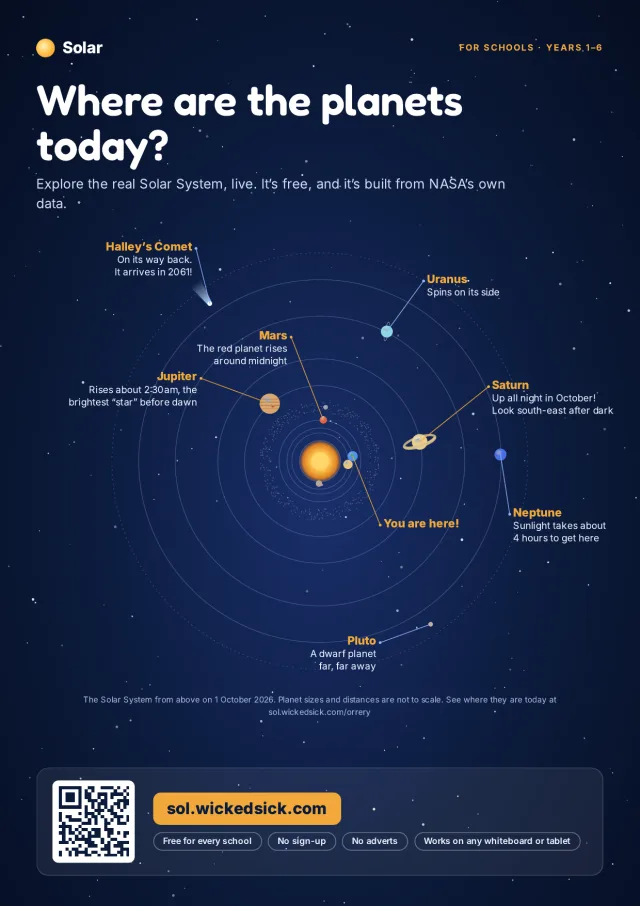 Primary. Key Stage 1 to Key Stage 2, US Kindergarten to Grade 5, ages 5 to 11
Where are the planets today?
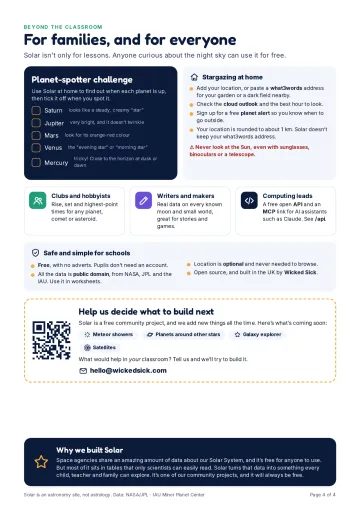
A friendly introduction to the real Solar System for primary classes: a map of where the planets are, the planets drawn to size, and short hands-on activities for KS1 · US Grades K–1 · Ages 5–7 and KS2 · US Grades 2–5 · Ages 7–11 (Lower and Upper KS2) linked to the National Curriculum.
Inside
-
-
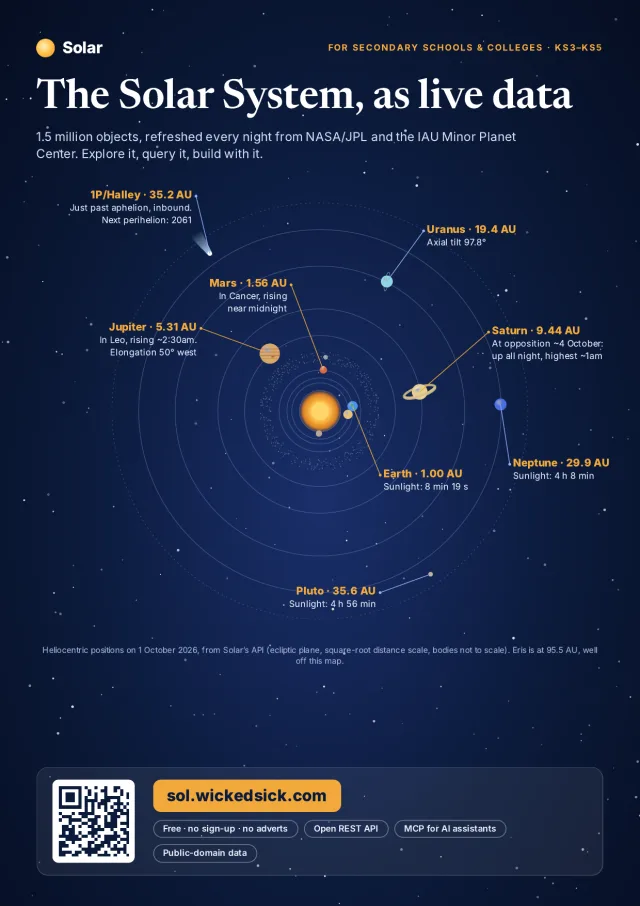 Secondary. Key Stage 3 to Key Stage 5, US Grades 6 to 12, ages 11 to 18
The Solar System, as live data
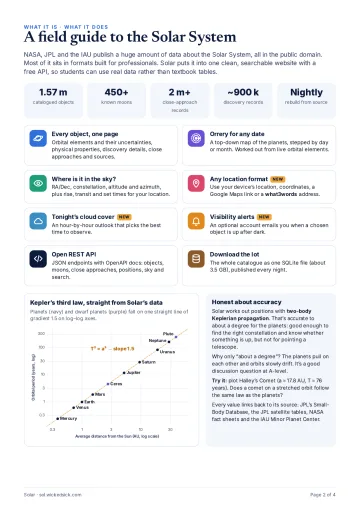
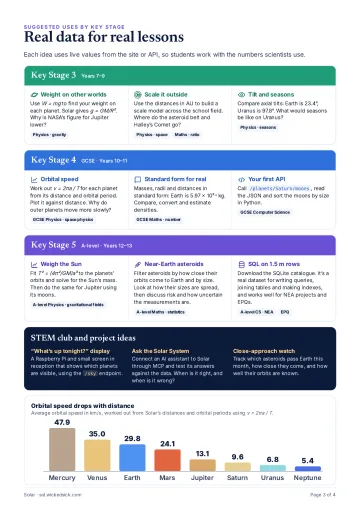
For secondary schools and colleges: the Solar System as a live dataset, with Kepler's third law straight from the catalogue, suggested uses for KS3 · US Grades 6–8 · Ages 11–14, GCSE (KS4 · US Grades 9–10 · Ages 14–16) and A-level (KS5 · US Grades 11–12 · Ages 16–18), STEM club projects, and a first look at the open REST API.
Inside
-
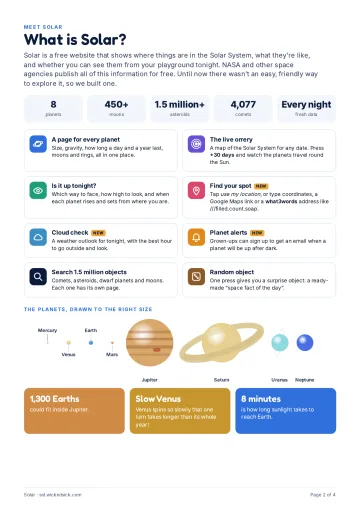
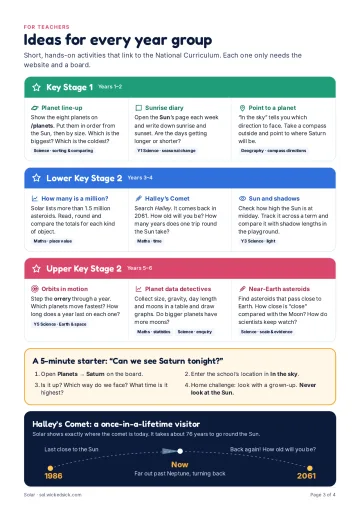
For classroom walls
Exoplanet poster series
Explore worlds beyond our Solar System with posters for primary and secondary classrooms. Vector artwork keeps text and illustrations sharp when printed from A3 up to A0.
The first posters are being prepared for download. Classroom handouts are available above in the meantime.
Using them in class
Every activity in the handouts points at a page on this site, so a whiteboard or a tablet is all you need. Follow the source links and their attribution and reuse terms when adapting data or images for your own worksheets. Open the orrery to show where the planets are today, or start with the planets.
Suggest a classroom activity or give feedback
Tell us what would help
Used one of these in a lesson? Want a sheet for a different year group or topic? We would love to hear from you: [email protected].